
Affiliate disclosure: This article contains affiliate links. If you choose to buy through them, AI Reviews may earn a commission at no extra cost to you.
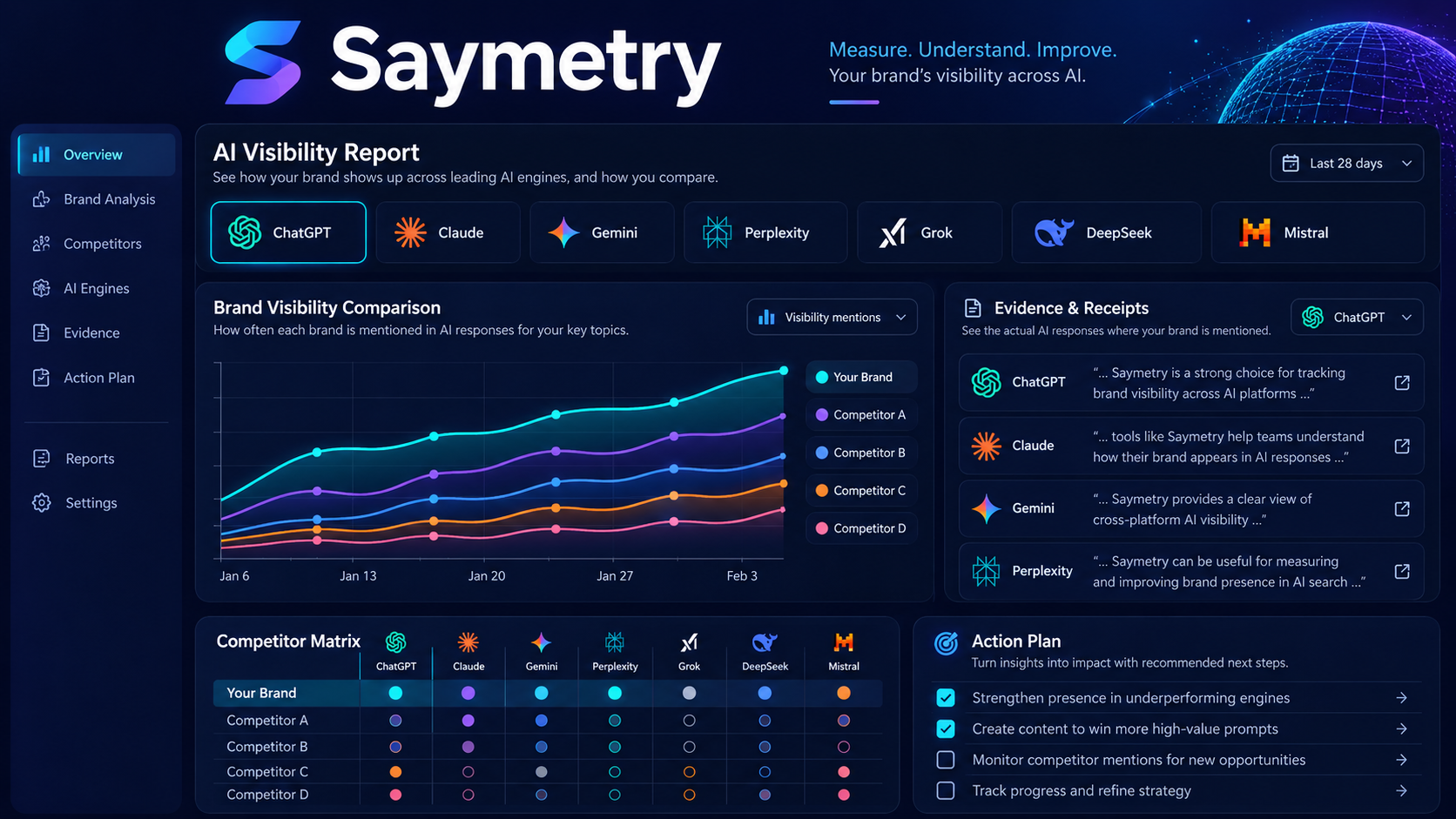
Saymetry is an AI-visibility measurement service for businesses that want to see how often their brand is recommended, cited or overlooked when prospective customers ask AI assistants for options in a market. It tests buyer-style questions across ChatGPT, Claude, Gemini, Perplexity, Grok, DeepSeek and Mistral, then provides the underlying answers, competitor context, a website audit and an action plan.
This Saymetry review is designed for a practical buyer decision. It is not a promise that a brand can force ChatGPT to recommend it—Saymetry itself states that no one can guarantee that outcome. The value is in seeing the answers, understanding which sources and pages influence them, and deciding whether the resulting actions are worth the cost.
Run a Saymetry AI visibility scan
Start with the question Saymetry actually answers
Traditional SEO reporting explains what happens in search results. Saymetry focuses on a different moment: a buyer asks an AI system a question such as “best project management tool for agencies” or “which local provider offers this service,” and the answer names some businesses but not others. The platform is built to document that recommendation landscape rather than reduce it to a vague “AI rank.”
For each scan, Saymetry says it writes buyer-focused questions for the market, queries all seven listed AI engines and retains the responses word for word. Its current materials describe around 60 questions and roughly 400 live answers per scan. The report then shows who is recommended, the themes in those recommendations, sources shaping the answers, a website audit and a prioritized action list.
That makes Saymetry most useful to a business that already has a market, competitors and a defined buyer journey. It is less useful for a new project with no clear offer or a company looking for a shortcut around useful pages, proof and customer trust.
The $249 scan: what you are buying
Saymetry currently presents its first product as a one-time Scan for $249, not a mandatory subscription. The official description includes the AI-engine results, a leaderboard of competitors, why-the-winners-win analysis, source evidence, a website audit, prioritized actions, a private web report and PDF, plus one free re-run if the original questions missed how buyers actually ask.
The strongest reason to buy a one-time scan is diagnostic clarity. For example, a marketing team may suspect that its content is not mentioned when buyers ask for comparisons, but not know whether the issue is weak product pages, missing third-party evidence, unclear positioning or simply a market where competitors are more established. A report that preserves the actual answers can turn that suspicion into a reviewable editorial and technical backlog.
It is not automatically worthwhile because it produces a score. Before purchase, define what you would do with the findings. If nobody can own the proposed page improvements, structured-data checks, competitive research or content gaps, the report may be interesting but not operationally useful.
How to read an AI visibility report without fooling yourself
Look for repeated patterns, not a single answer
AI answers can vary by prompt, date and engine. Saymetry’s site specifically emphasizes confidence ranges and separating a meaningful movement from noise. That is the right mindset for any AI-visibility tool: a single flattering response is not evidence of durable market visibility, and a single omission does not prove a brand is absent everywhere. Look at repeated buyer questions, the engines that matter to your audience and changes that exceed normal variation.
Read the cited sources and competitor reasons
If a competitor appears often, the useful next question is not “how do I copy them?” It is “what proof, page type, source or positioning does the answer rely on?” A practical action might be to clarify service pages, publish a buyer comparison, improve product documentation, earn relevant coverage or correct inconsistent company information. Do not manufacture claims or fake reviews merely to influence a model; the input must still be useful and truthful for real customers.
Treat the plan as an editorial queue
A prioritized action list is only valuable when it becomes owned work. Turn each item into a clear task with an accountable editor, developer or marketer. Saymetry reports that its dashboard allows actions to be marked complete and later scans to measure movement. That can make the tool useful as an experimentation loop, but it should not replace web analytics, sales data or direct customer research.
Which purchase path fits your situation?
| Your situation | Reasonable choice | What to validate |
|---|---|---|
| You have never checked AI answers in your category | One-time Scan | Whether your brand, competitors and buyer questions are represented accurately. |
| You are already improving pages and need a baseline | Scan, then consider Tracking | Whether the report creates a specific action backlog and a repeatable measurement plan. |
| You have a changing competitive market or agency clients | Tracking may be suitable | Whether weekly changes, alerts and multi-stakeholder reporting justify the recurring spend. |
| You need the work implemented for you | Review custom services carefully | Scope, deliverables, approvals, ownership and what evidence will measure progress. |
Current pricing and what it includes
At the time of review, Saymetry lists the one-time Scan at $249. Its Tracking option is listed at $149 month-to-month or $119 per month when billed annually, with $1,428 charged upfront for the year. The first full scan is included with Tracking, and the site says a previously purchased $249 Scan is credited at checkout. The service also lists custom work: a Custom Deep Report at $1,990, Market Strategy at $1,490 and implementation starting from $2,990.
These figures are current published product information, not a guarantee of future pricing. Compare the live checkout and scope before purchasing. For annual tracking, be especially clear about the upfront commitment, the questions being monitored, cancellation conditions and whether your team can act on the alerts.
A 14-day buyer workflow
- Write the buyer questions first. List the comparison, price, trust, local and use-case questions real prospects ask. Avoid questions that only your internal team cares about.
- Run the scan against a defined market. Give accurate business, customer and geography context. A poor market definition will create poor comparisons.
- Review the evidence as a team. Read the actual AI answers, cited sources and competitor explanations. Separate factual fixes from content opportunities and speculative ideas.
- Choose a small action set. Assign 3–5 high-confidence improvements, such as correcting an outdated page, explaining a use case or improving structured content. Do not rewrite the whole website from one report.
- Measure more than visibility. Track referral traffic, qualified enquiries, conversion behavior and customer feedback alongside the report. Being mentioned does not automatically create revenue.
- Decide on Tracking only after the work begins. A recurring dashboard makes more sense when there are ongoing improvements and competitive movements to observe.
Where Saymetry differs from ordinary rank tracking
Rank tracking follows positions in search results. Saymetry’s stated focus is recommendation and citation behavior inside seven AI assistants, along with the answers and sources behind those outcomes. The two activities can complement each other, but they are not interchangeable. Strong organic pages may help create better source material, while an AI-visibility report may reveal questions or comparative language your content has not addressed.
Do not assume that an AI visibility report replaces technical SEO. Indexability, crawlability, useful internal links, clear page structure, real authority and accurate business information remain important. A tool can show what is happening; it cannot make thin content, unverified claims or an unclear offer competitive on its own.
Limitations and buyer checks
- AI outputs are variable. Focus on recurring evidence and confidence information rather than one attractive screenshot or one bad result.
- Saymetry cannot guarantee recommendations from ChatGPT or any other engine; its own materials are direct about this limitation.
- Competitor findings are prompts for investigation, not permission to copy claims, content or branding.
- The quality of the report depends on how accurately the buyer market, questions and company information are defined.
- Tracking is a recurring investment. Buy it when the team has an active program of improvements, not merely curiosity.
- For done-for-you services, obtain the exact scope, access requirements and approval process in writing before sharing website access.
Final verdict
Saymetry is a focused option for a business that wants evidence about its brand’s place in AI-generated buying recommendations. The $249 one-time Scan is the natural starting point because it delivers a concrete diagnostic before committing to a subscription. It is most valuable when a team can turn the report into truthful page, content and trust improvements, then evaluate real business outcomes alongside any visibility change.
Visit Saymetry and view the current scan options
FAQ
Can Saymetry guarantee that ChatGPT recommends a business?
No. Saymetry states that no provider can honestly guarantee a recommendation from an AI engine. Its role is to measure answers and identify practical inputs a business can improve.
How many AI engines does Saymetry cover?
The current product page lists seven: ChatGPT, Claude, Gemini, Perplexity, Grok, DeepSeek and Mistral.
Is Saymetry a monthly subscription?
Not necessarily. The initial Scan is currently presented as a one-time $249 purchase. Tracking is optional and is offered on rolling monthly or annual-billing terms.
Does the report replace SEO work?
No. It can reveal useful questions and source gaps, but technical SEO, helpful content, credible evidence and site quality still require ongoing work.