

Affiliate disclosure: This article contains an affiliate link. If you choose to purchase through it, we may earn a commission at no additional cost to you.
Personalized outbound is valuable only when the message gives a real reason to reply. PipeLime AI positions its outreach workflow around live company research, email and LinkedIn sequences, adaptive follow-ups, reply handling, and meeting booking. This guide focuses on that function for B2B buyers who already have a defined offer and ideal customer profile.
Explore PipeLime AI’s current plans and start options →
What PipeLime AI means by hyper-personalized outreach
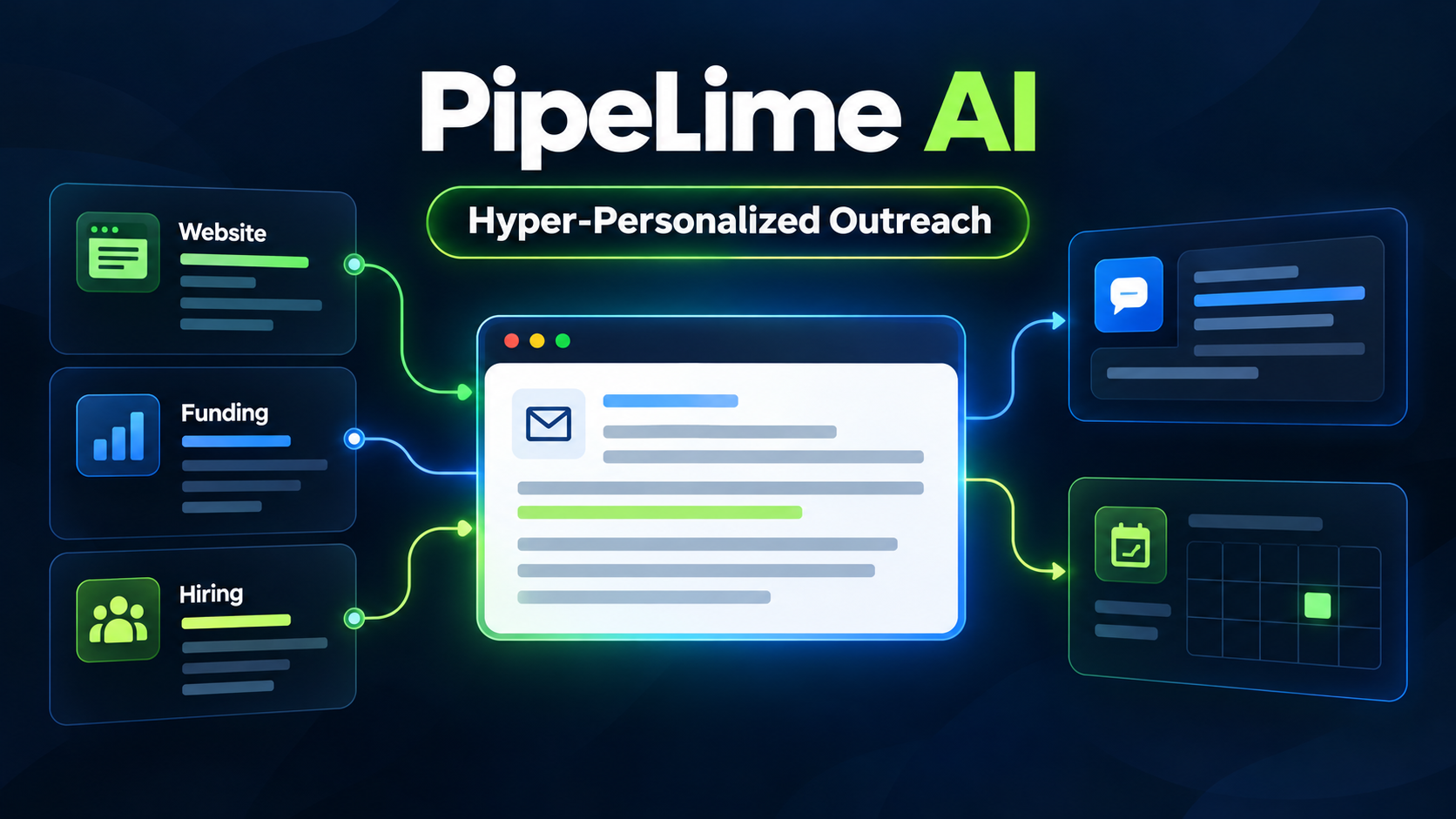
PipeLime says its AI sales agent researches a prospect before writing: company websites, LinkedIn activity, hiring, funding, technology context, and news are examples of signals described on its public feature pages. The practical goal is not to insert a first name into a template. It is to connect a truthful observation to a relevant business problem and a concise next step.
For a SaaS founder selling RevOps services, for example, the usable context might be an SDR hiring push, a new market launch, or a visible gap between lead volume and follow-up capacity. The message should still be reviewed against reality. AI-generated personalization can sound credible while being inaccurate, stale, or irrelevant.
How the workflow can run
- Define the audience and the offer. Set firmographic filters, the job roles that own the problem, and the one outcome your offer can substantiate.
- Research the account. PipeLime describes gathering live context before drafting the outreach.
- Write an on-brand opening. Set approved talking points, tone, prohibited claims, and a short call to action. Do not let automation invent customer results or competitive claims.
- Run a coordinated sequence. The product describes one thread across email and LinkedIn, with follow-ups that can react to opens, clicks, replies, or inactivity.
- Qualify and book. Interested prospects can be routed toward a calendar; the sales team should retain responsibility for discovery and close decisions.
Where this is most useful
PipeLime’s approach is most plausible for B2B teams with a focused market, a credible offer, and enough research signals to support a relevant message. Agencies, consultants, founders testing a narrow segment, and SDR teams with a documented playbook are better candidates than businesses trying to create demand with a broad, generic blast.
It can also reduce tool switching when a team wants prospect research, email, LinkedIn, replies, follow-ups, and meeting creation in a connected workflow. For the wider product picture—including pricing, verification, warm-up, and CRM considerations—see our PipeLime AI review and buyer guide.
Important limits before you automate
- Personalization is not permission. Follow applicable privacy, marketing, and platform rules. Use accurate sender identities and an easy way for recipients to decline further contact where required.
- Signals need verification. A funding announcement, job post, or social update can be outdated or misread. Review the examples before launching volume.
- Reply quality matters more than send volume. Track positive replies, qualified meetings, opportunity creation, bounces, and complaints—not just opens.
- Channel access has constraints. Confirm what your selected PipeLime plan and connected LinkedIn/email accounts support. Do not assume every workflow or integration is available in every configuration.
- Human judgment stays essential. Complex objections, security questions, pricing discussions, and enterprise qualification should have an approved handoff path.
A controlled 30-day test
Start with one segment and one offer. Build a small list, inspect the research notes and first messages manually, then send in modest batches. Compare messages against a human-written control. After one to two weeks, look at deliverability, reply quality, booked-meeting rate, and the percentage of replies that actually match the intended buyer. Scale only when the evidence is positive.
Who should consider PipeLime AI for outreach?
Consider it if you want one platform for research-led B2B email and LinkedIn outreach, adaptive follow-up, and calendar handoff—and you can supply a clear ICP, approved positioning, and oversight. Choose a simpler tool if you only need a one-off email campaign or an isolated scheduling link.
Check PipeLime AI’s current product details and pricing →
Product capabilities and pricing can change. Confirm the current plan, integrations, data practices, sending limits, and refund terms directly with PipeLime before purchase.
How to evaluate PipeLime AI before you buy
A strong product demo is not a proof that an outbound program will work. Evaluate PipeLime as a connected workflow: data quality, research relevance, message controls, sending infrastructure, reply routing, and sales handoff all need to work together. Ask to see the exact path your team will use, not only a polished sample account.
1. Test data quality against your real ICP
Create one narrow segment with the company size, geography, industry, job functions, and seniority levels you actually sell to. Review a sample manually. Are the accounts plausible? Are the named contacts people who can influence the purchase? Do the contacts have a clear reason to care now? A larger list is not better if the fit is weak.
PipeLime publicly describes lead generation, decision-maker targeting, and in-house verification as connected capabilities. Buyers should still validate the current data coverage for their niche, the availability of direct contact details, and how credits are consumed. A specialist audience or a non-English market may need a different test than a broad US SaaS campaign.
2. Inspect the research behind the copy
Request the research sources behind several generated opening lines. Good personalization references a specific, verifiable signal and relates it to the offer. Weak personalization restates generic company information, guesses at priorities, or makes a claim the prospect never made. Create a rejection rule for messages that cannot be fact-checked in seconds.
Set clear guardrails before activating automation: approved claims, excluded industries, sensitive topics, competitor references, pricing language, and the conditions that require a human review. The most useful AI outreach system is not the one that writes the most text; it is the one that reliably stays inside the team’s positioning.
3. Validate multichannel sequencing
PipeLime presents email and LinkedIn as part of a coordinated outbound workflow. Check how the sequence behaves after a reply, a connection request, an opt-out, a bounce, or a calendar booking. You want one coherent conversation per prospect—not two disconnected campaigns that repeat themselves. Confirm channel permissions and account limits directly with the relevant platforms and your selected PipeLime plan.
4. Protect deliverability before increasing volume
Even highly relevant copy performs poorly if it lands in spam. PipeLime says it includes email verification and inbox warm-up, but buyers should confirm the sending setup, sender-domain strategy, daily ramp, and health reporting for their account. Start with modest volume, inspect bounce classifications, and stop the campaign if complaints or hard bounces rise unexpectedly.
For a deeper look at the verification layer and the questions to ask, read our upcoming PipeLime email-verification buyer guide. The practical rule is simple: do not use a new automation platform as an excuse to send more before you can measure sender reputation and meeting quality.
Buyer scorecard: five questions that matter
| Question | What a useful answer looks like |
|---|---|
| Can it find the right buyer? | A test list that matches your ICP and surfaces the right job functions—not merely a high contact count. |
| Is the message genuinely relevant? | Every opening line is tied to a reviewable signal and an approved value proposition. |
| Can we control the sequence? | Clear stop rules, review steps, channel logic, and safe handling of replies or opt-outs. |
| Will it fit our stack? | Current, confirmed calendar and CRM behavior for the tools your team actually uses. |
| Can we measure business impact? | Reporting that connects sends to replies, qualified meetings, opportunities, and pipeline—not vanity metrics alone. |
Common mistakes with AI outreach tools
- Starting with too many segments: One audience and one offer make it possible to learn from replies. Broad targeting hides why a campaign succeeds or fails.
- Letting templates become generic: A message can use AI and still read like a mass email. Retire any opening that cannot pass a simple relevance check.
- Measuring open rate as the primary result: Privacy changes and tracking limitations make opens unreliable. Favor qualified conversations and revenue-stage outcomes.
- Automating objection handling without a playbook: Define what the agent may answer, when it should hand off, and how it records the outcome.
- Ignoring operational ownership: Decide who reviews reply quality, monitors deliverability, approves changes, and maintains the CRM handoff.
PipeLime AI versus a lighter outreach setup
A lightweight stack can be the better choice when you only need a single function: a contact verifier, a manual email tool, or a scheduling link. PipeLime is worth evaluating when your team wants prospect discovery, enrichment, personalized email and LinkedIn activity, follow-ups, reply handling, and booking to operate as one motion. The trade-off is setup complexity and the need to validate more moving parts.
Do not assume an all-in-one workflow replaces best-of-breed depth in every area. Compare the exact integrations, limits, deliverability controls, data coverage, and reporting you need. Then run a small paid or pilot test against the cost and coordination burden of the existing stack.
Frequently asked questions
Does PipeLime AI write every message automatically?
PipeLime describes AI-assisted research, personalized copy, adaptive follow-ups, and contextual reply handling. Buyers should configure their voice, approved claims, and review rules, then inspect messages before scaling.
Can PipeLime AI replace an SDR team?
No. It may automate repetitive research and outreach steps, but human sellers still own positioning, qualification, complex conversations, and closing.
Is AI personalization enough to improve reply rates?
No. Relevance depends on the offer, list quality, sender reputation, timing, and truthfulness. Use a controlled test and compare qualified responses rather than relying on promises or generic benchmarks.
What should a first campaign measure?
Track delivered messages, hard bounces, positive replies, qualified meetings, show rate, opportunities created, and unsubscribes or complaints. Review message samples alongside the numbers.
Bottom line
PipeLime AI’s outreach capability is most compelling for B2B teams that have already done the hard strategic work: they know the buyer, the problem, the proof points, and the sales handoff. Use the platform to make a disciplined motion more consistent—not to hide an undefined offer behind automated volume. Review PipeLime AI’s current plans and product details →