

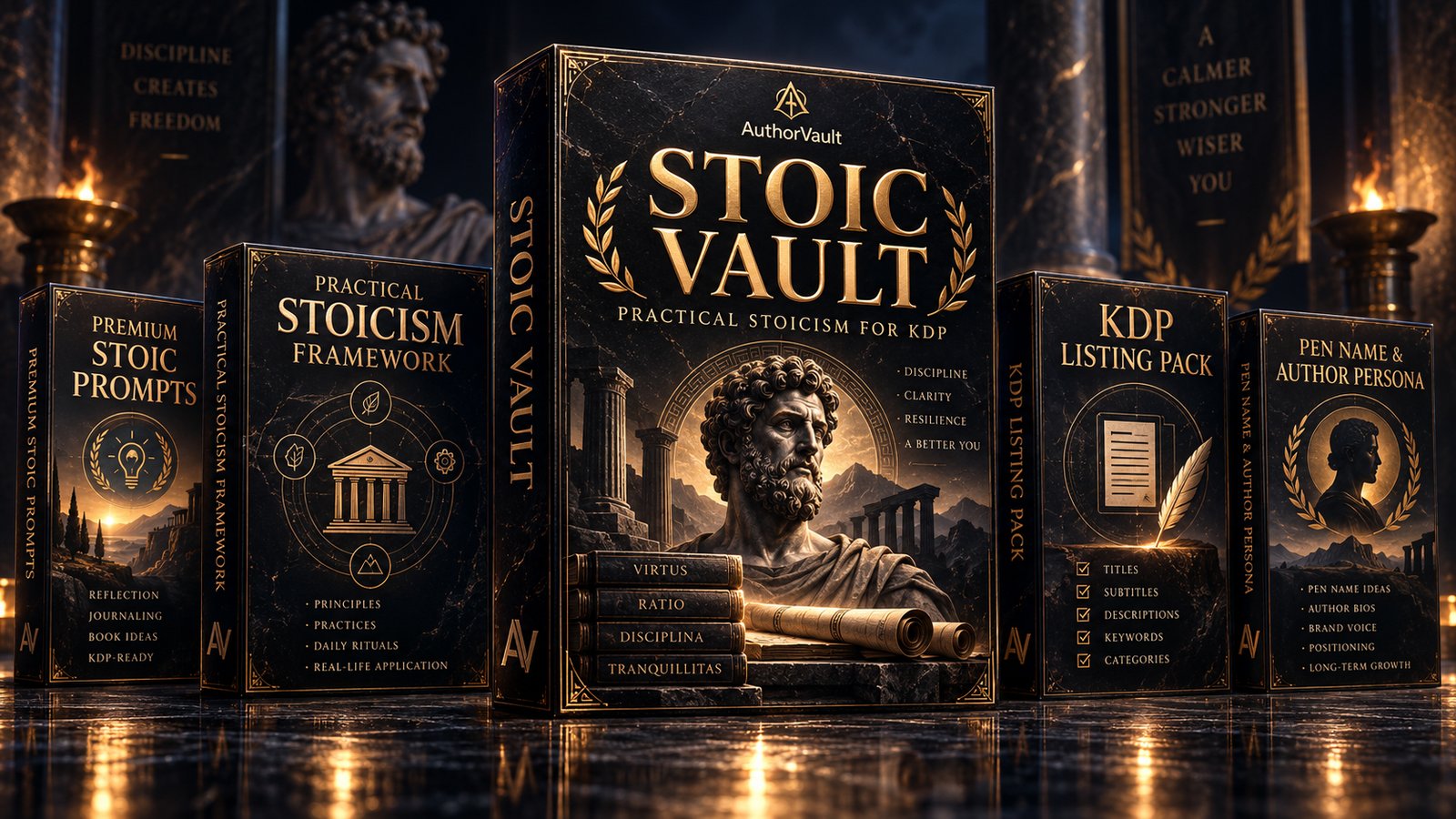
Last updated: September 25, 2026. This AuthorVault Stoic Vault review examines the software ahead of its scheduled October 5, 2026 launch. We reviewed the official product and partner materials, pricing, workflow, and funnel. We have not used a production account, published a book with it, or independently verified claims about sales or output quality.
Affiliate disclosure: This article contains affiliate links. If you purchase through one of these links, AI Reviews may earn a commission at no extra cost to you. This does not change our editorial assessment.
AuthorVault Stoic Vault Review: The Short Decision
AuthorVault Stoic Vault is a guided AI-assisted writing workspace for creating practical Stoicism books for Amazon KDP. Its clearest advantage is focus. Instead of opening a general chatbot and inventing a process, buyers are given a niche-specific path from concept and book planning through chapter drafting, formatting, cover preview, and export.
That focus can help a beginner organize a project, but it does not turn an unedited AI draft into a trustworthy book. Stoicism is a field in which quotations are frequently misattributed, historical context matters, and generic advice can quickly become repetitive. The software is most useful as a structured production assistant for a publisher willing to fact-check, rewrite, add a distinct point of view, and comply with Amazon’s current content-disclosure rules.
Best fit: an indie publisher who already understands book positioning and wants a repeatable workspace for a practical Stoicism series. Poor fit: anyone expecting a one-click passive-income system, authoritative philosophical research, or guaranteed KDP sales.
What Stoic Vault Actually Is
Stoic Vault is part of the AuthorVault product family from Ryan Mac. The vendor describes AuthorVault as one dashboard that receives niche-specific writing vaults. Stoic Vault is the practical non-fiction edition, aimed at accessible books about resilience, discipline, clear thinking, and applying Stoic ideas to modern problems.
The distinction matters because this is advertised as a built-in workflow rather than a downloadable prompt sheet or a custom GPT. The workspace is said to include chapters, a manuscript view, formatting tools, a cover preview, and export. The niche bot guides the user through the sequence instead of leaving every prompt and file-management choice to the user.
The product does not replace Amazon KDP, professional editing, original research, or a launch plan. Think of it as the drafting and assembly layer. You still need to choose a defensible angle, verify claims and quotations, improve the prose, commission or create a legally usable cover, upload the finished files, and earn reader attention.
What is advertised in the front end
- A four-phase path for planning and drafting practical Stoicism non-fiction.
- A niche-restricted assistant rather than a blank general-purpose chatbot.
- Concept, book-bible, chapter, manuscript, formatting, cover-preview, and export tools.
- A workflow intended for Amazon KDP projects and possible series development.
- Access inside the broader AuthorVault dashboard.
These are vendor-described features. The final checkout page, license, export formats, usage limits, and support terms should be reviewed before purchase.
The Four-Stage Workflow, Examined as a Publisher
A useful way to judge Stoic Vault is to follow a manuscript from idea to upload and ask what the software contributes at each point.
1. Position the book before drafting it
The concept stage should define one reader, one practical problem, and one promised transformation. “A book about Stoicism” is too broad. A more workable project might address decision-making under pressure, recovering focus after failure, or using the dichotomy of control at work. A focused brief also reduces the risk that the generated chapters repeat the same broad advice.
2. Build a book bible that enforces consistency
The book-bible step is potentially the most valuable part of a guided system. It can hold the audience, voice, chapter purpose, recurring examples, terminology, and boundaries. That shared context helps keep a multi-chapter manuscript coherent. The user still needs to decide what belongs in the book; a structured form cannot determine whether the premise is original or commercially useful.
3. Draft chapter by chapter
Chapter-level generation is easier to review than asking an AI model for an entire book at once. Each chapter can be checked against its purpose, stripped of repetition, and enriched with original examples. The sensible workflow is draft, verify, rewrite, and then connect the chapter to the next one. Publishing the first output unchanged would waste the main advantage of having a controlled workspace.
4. Assemble and export the manuscript
The manuscript, formatting, cover-preview, and export tools address the practical friction between a folder of drafts and an uploadable book. Buyers should verify the exact supported formats and inspect the exported file on multiple devices. KDP formatting failures often appear in headings, page breaks, tables of contents, image placement, and front or back matter rather than in the main paragraphs.
Who Has a Credible Use Case?
| User | Potential value | Main risk |
|---|---|---|
| First-time KDP publisher | A visible sequence can reduce blank-page and file-management friction. | Mistaking a guided draft for a finished, differentiated book. |
| Experienced indie publisher | May speed up outlines, first drafts, and repeatable series planning. | Workflow may feel restrictive if an established process already works. |
| Stoicism educator or practitioner | Can combine domain knowledge with a faster production system. | Must protect nuance and avoid flattening philosophy into slogans. |
| Agency or ghostwriter | Could provide a consistent starting framework for client manuscripts. | Licensing, disclosure, originality, and client expectations require care. |
| Passive-income seeker | Low entry price makes the workflow easy to inspect. | No software can guarantee demand, rankings, reviews, or royalties. |
Choose it if these statements are true
- You specifically want to publish accessible, practical Stoicism content.
- You prefer a step-by-step workspace over assembling prompts manually.
- You are willing to edit substantially and verify every historical or philosophical claim.
- You have a plan for covers, listings, reader acquisition, and ongoing catalog quality.
Skip it if these statements are true
- You only want a general AI writer that can handle any genre or business task.
- You expect the software to research primary philosophical texts accurately on its own.
- You intend to upload raw generated text at scale.
- You do not want to review Amazon’s current rules for AI-generated content and publishing rights.
Five Quality Gates AI Cannot Replace
- Quotation verification. Check every quote against a reliable edition. Social media has spread many modern sayings under the names of Marcus Aurelius, Seneca, and Epictetus.
- Interpretive accuracy. Practical advice should not be presented as ancient doctrine unless the connection is supported. Separate your modern application from what a historical source actually says.
- Original contribution. Add a real framework, examples, exercises, case analysis, or a distinct sequence. Rephrasing familiar Stoic maxims is unlikely to produce a memorable book.
- Human line editing. Remove repetition, vague transitions, inflated certainty, and the uniform rhythm common in generated prose. Read the manuscript aloud and test every exercise.
- Publishing compliance. Confirm that you hold the necessary rights for text, cover elements, and any included material. Review Amazon’s current AI-content disclosure and quality policies before uploading.
These checks are also the difference between a useful authoring tool and a content-volume shortcut. Stoic Vault can organize work, but the publisher remains responsible for truth, originality, reader value, and compliance.
AuthorVault Stoic Vault Pricing and Funnel
The official launch material lists the front end at $17 during the launch period, with a planned increase to $27. It also describes a 14-day conditional guarantee. Checkout terms control, so read the live page before paying.
| Level | Advertised price | What it adds |
|---|---|---|
| Stoic Vault front end | $17 launch price, planned $27 | The niche writing bot and core vault workflow. |
| Stoic Launch Pack bump | $17 | Keyword sets, blurb templates, and pen-name or author-persona material. |
| Author Toolkit Pack | $67 | Promotional scripts, media-kit items, outreach templates, and listing helpers. |
| Premium Stoic Prompts | $57 | Additional prompts for sub-angles and series-style catalogs. |
| AuthorSpot Multi Pen Name | $67 funnel price | Five author profiles with lifetime access, according to the partner page. |
| BookSalesRocket Unlimited | $97 | A separate promotion and book-launch tool. |
The front end should be judged on whether its core workflow is worth $17 to you. Do not assume every upgrade is required. Add-ons address listing, author-brand, prompt, and promotion tasks that can also be handled with other tools or a manual process.
Questions to answer at checkout
- Is access lifetime, subscription-based, or subject to usage limits?
- Which AI model or credits power generation, and are future costs possible?
- What export formats are included in the front end?
- What commercial-use rights apply to generated manuscripts and covers?
- What exactly must be completed to qualify for the conditional refund?
Alternatives and Trade-Offs
General AI assistant plus a manual template
A general chatbot and a carefully maintained outline can provide more flexibility. You choose the research sources, prompts, and editing process. The trade-off is setup time and the need to maintain consistency across many chats and documents.
Traditional writing and formatting tools
A word processor paired with dedicated formatting software gives the author direct control and avoids dependence on a niche platform. It is slower at ideation and first-draft generation but may suit writers who already know their subject and voice.
Human editor or ghostwriter
Professional help costs much more but can contribute judgement, research discipline, voice, and accountability. For a book intended to build a durable expert brand, human editorial involvement may be more valuable than producing additional titles quickly.
Stoic Vault’s case rests on convenience: a narrow workflow, a low front-end price, and the AuthorVault dashboard. Its weakness is the same narrowness. If you move away from practical Stoicism or need a highly customized scholarly workflow, the product may no longer fit.
For more software evaluations using the same evidence-first standard, browse our AI product reviews.
Final Verdict: Useful Structure, With a Serious Editing Obligation
AuthorVault Stoic Vault is an interesting specialist tool because it tries to solve workflow friction rather than selling a loose collection of prompts. The concept-to-book-bible-to-chapter-to-export path is understandable, and the $17 launch price makes the core product relatively accessible.
Our reservation is not that AI participates in the workflow. It is that the subject demands more care than a generic low-content project. A credible Stoicism book needs accurate attribution, responsible interpretation, original examples, and a human voice. The stronger your subject knowledge and editorial standards, the more useful the vault may become. The weaker those inputs are, the more likely the output is to blend into undifferentiated AI-assisted publishing.
AI Reviews verdict: consider the front end if you want this exact niche and will treat it as a structured drafting environment. Avoid buying the funnel on the assumption that software alone creates authority, demand, or KDP income.
Frequently Asked Questions
What is AuthorVault Stoic Vault?
It is a niche-specific AI-assisted writing workspace for planning, drafting, formatting, and exporting practical Stoicism books intended for Amazon KDP.
Is Stoic Vault a custom GPT?
The vendor says it is a built-in AuthorVault bot and workspace, not a custom GPT. The advertised tools include chapters, a manuscript view, formatting, cover preview, and export.
How much does Stoic Vault cost?
The official pre-launch information lists a $17 front-end launch price with a planned increase to $27. Optional funnel products cost extra, and live checkout pricing may change.
Can Stoic Vault guarantee Amazon KDP sales?
No. Sales depend on reader demand, book quality, positioning, cover and listing quality, reviews, promotion, competition, and other factors outside the software.
Does AI Reviews claim hands-on testing?
No. This is a pre-launch analysis based on the official product and partner materials. We have not used a production account or independently measured output quality.