

Affiliate disclosure: This comparison contains affiliate links. If you purchase through a link, we may earn a commission at no additional cost to you. Our conclusions are based on the products’ published information and a workflow-focused comparison; prices, limits, and features can change.
Choosing between Undetectable AI and UndetectedGPT is less about finding a magic button and more about choosing the writing-refinement workflow that matches your work. Both products position themselves around revising AI-assisted text so that it reads more naturally. Both also market detection-related capabilities. Neither should be treated as a guarantee that a piece of writing will receive any particular result from an AI detector, meet an institution’s policy, or replace responsible editing.
The useful buyer question is narrower: which product gives you the controls, capacity, and integration path you need to refine legitimate drafts, then review them carefully before publication? Undetectable AI is the broader platform, with humanization, detection-related tools, and a developer/API offering. UndetectedGPT is more focused on a writing-refinement workflow, with tones, document editing, a detector, and a separately documented pay-per-word API. For many individual writers, the distinction is practical rather than philosophical.
Explore Undetectable AI and current plan details →
Explore UndetectedGPT and current plan details →
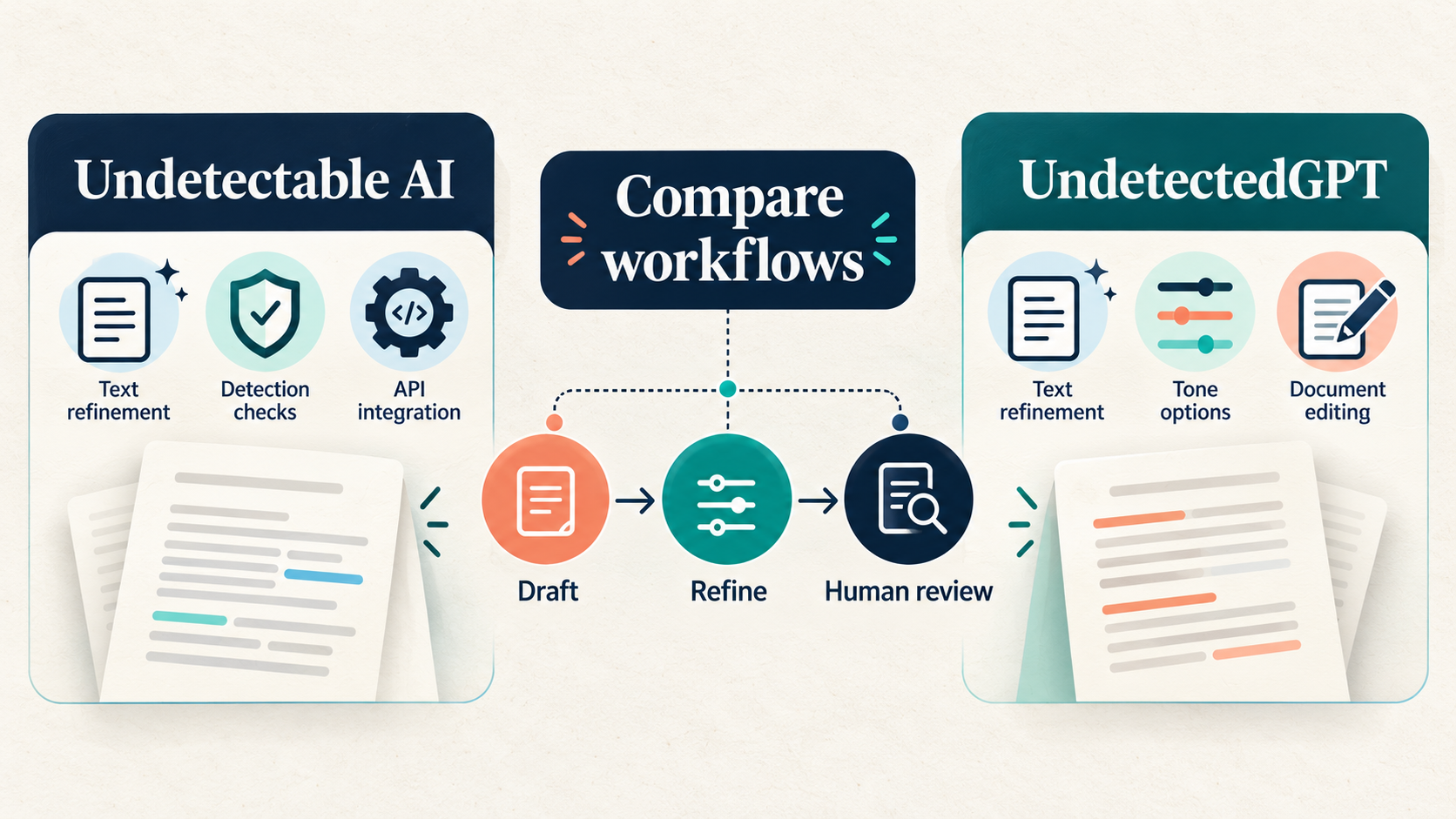
At a glance: the practical difference
Undetectable AI is the more expansive option if you expect a text-refinement tool to sit beside detection checks or developer integration. Its official developer page describes a Humanizer API and access to text, image, audio, video, and writing-style APIs. The company’s help material also documents subscription options and word-based plans. That wider scope may be useful to a team testing several related capabilities or to a developer building an internal editorial step.
UndetectedGPT is the more focused candidate when the immediate job is revising a draft for tone, readability, and a clean handoff into an existing document workflow. Its public plans describe a humanizer, detector credits, tone options, Ghost Mode, and an AI document editor. Its API documentation describes a separate service with a humanize endpoint, selectable models, tone parameters, and a pay-per-word balance. A compact workflow can be a virtue when you do not need an ecosystem around it.
Read the underlying buyer guides before choosing: our Undetectable AI review and our UndetectedGPT review. Those pages include the current affiliate destinations used in this comparison.
AI writing refinement: what each tool is really for
In a legitimate editorial workflow, “humanization” is best understood as a revision pass. You provide a draft, specify an intended tone or output setting where available, inspect the rewrite, compare it with the source, and decide what to retain. That can be useful for converting an overly formal first draft into clearer customer-facing copy, smoothing repetitive phrasing in a product description, adapting a campaign draft to a defined brand voice, or creating a starting point for a multilingual editor. It is not a substitute for subject-matter expertise, fact checking, or authorship disclosure where a client, employer, publisher, or school requires one.
Undetectable AI’s official materials frame its core text product around making AI-generated content more human-like. It also offers writing-level matching and a broader developer surface. The fit is strongest when you want to test a refinement step alongside detection-related checks or plan to use an API. Its official help documentation lists many supported languages, which may matter for multilingual teams; test your actual language and content type rather than assuming equal quality across every use case.
UndetectedGPT’s published product and API pages emphasize text humanization, tone selection, document editing, and language support. The documented API accepts text and offers academic, balanced, conversational, formal, and creative tone values. That makes it a reasonable tool to trial if your recurring task is taking an internal draft and producing a more readable version for an editor to assess. The right test is not whether the first output sounds impressive in isolation. It is whether it reduces editing time while preserving the facts, intent, terminology, and voice you need.
Detection-related features and claims: keep expectations conservative
Both products use detection-oriented marketing language. That language should not be mistaken for a dependable way to determine authorship or to promise a detector outcome. AI detectors can produce false positives and false negatives, their scoring approaches change, and different detectors can disagree on the same text. A result from any detector is a signal to investigate, not proof of authorship, honesty, or misconduct.
Undetectable AI publishes a text detector and detection-related APIs alongside its humanizer. UndetectedGPT’s public pricing page lists an AI Detector and detector credits, while its product pages make broad detector-related claims. These are features to evaluate, not warranties to rely on. If detection is relevant to your process, use it as one checkpoint alongside version history, source notes, disclosure procedures, editorial review, and the rules of the organization receiving the work. Do not use either product to misrepresent who wrote something, to evade accountability, or to bypass academic integrity requirements.
This caution is especially important in schools and regulated settings. A student should do their own thinking and follow the course’s AI policy. A legal, medical, financial, or safety-related draft needs qualified review and source verification. A marketing team must check claims, permissions, and brand standards. The safer purpose for a refinement tool is improving clarity in work you are authorized to edit, not concealing the origin of work or making unsupported representations.
Workflow comparison: editor, reviewer, and developer perspectives
For an individual writer or editor
Start with the smallest real project you can safely use: a non-sensitive email sequence, a rough product introduction, or a documented internal draft. Preserve the original. Define three success criteria before you run anything: factual accuracy, tonal fit, and the time required to reach a publishable version. Then compare the source and output sentence by sentence. Watch for changed numbers, softened caveats, invented examples, awkward transitions, or a generic voice. If the output creates more cleanup than it saves, the tool is not a fit regardless of its headline claim.
UndetectedGPT may be the simpler trial for writers who primarily want tone and document-focused refinement. Undetectable AI may make more sense for an editor who also wants to explore its broader product family. In either case, a human editor should make the final call.
For a content team
Teams should look past the rewrite itself. Check whether the product supports the languages you use, how it counts words or credits, what happens when a request fails, whether you can export cleanly, and how the work moves into your CMS or approval process. Do not paste confidential briefs, customer data, unpublished contracts, health data, or credentials into a tool until your organization has reviewed the provider’s current privacy terms and approved that use. Keep backups of original text and track meaningful editorial changes.
Undetectable AI’s documented API options can be relevant if a team needs an integration route. UndetectedGPT documents an API geared to a programmatic humanization step, including rate limits and word-balance billing. A developer should validate authentication, rate limits, error handling, privacy obligations, and review gates in a non-production test before connecting either service to a publishing pipeline.
For developers
Undetectable AI publishes Humanizer and detection-related API information, with word-credit billing tied to its account model. UndetectedGPT documents a REST endpoint for humanization, model and tone parameters, and a separate pay-per-word purchase model for its API. These are not directly interchangeable price lists: the web products and the APIs may have different billing, limits, and features. Confirm the current official documentation and checkout terms before budgeting an integration.
A responsible implementation should also prevent an automated rewrite from going live unreviewed. Log the source and output where appropriate, remove sensitive data before sending it, add a human approval stage, and verify every factual or compliance-sensitive statement. Treat API latency and usage caps as production concerns, and test failure behavior rather than assuming a request always succeeds.
Pricing and credits: documented snapshots, not promises
Pricing is easy to overstate, so check the official pages immediately before buying. At the time this comparison was prepared, Undetectable AI’s public pricing material described monthly word allowances beginning at $19 per month for 20,000 words and annual pricing beginning at an effective $5 per month for 10,000 words, billed annually. Its official pages also describe business options and API-related word credits. The site’s prices, availability, promotions, included features, and cancellation terms can change.
UndetectedGPT’s public pricing page listed a free tier plus Plus at $19.99 per month, Pro at $29.99 per month, and Max at $79.99 per month, with stated monthly credits, detector credits, boosts, and per-request word limits that vary by tier. Its API page separately listed one-time word packs rather than a subscription: 190,000 words for $95, 400,000 for $180, and 2 million for $750 at the time of review. Again, verify the live checkout because promotions and plan terms may differ.
Compare price against finished, reviewed work, not raw generation volume. Include the cost of retries, the time an editor spends correcting output, and whether the plan forces an upgrade during normal revision cycles. A cheaper plan is poor value if it introduces a bottleneck; the largest plan is unnecessary if a small pilot shows the workflow does not help.
Privacy, verification, and limitations
Before uploading text, read the provider’s current privacy policy, terms, and data controls. Do not assume that a polished interface means a suitable environment for client-confidential, personal, regulated, or unpublished material. Redact identifiers where possible. Keep original copies. Check the output in the destination format, not only in the tool’s preview. If the result will be published, verify names, facts, quotes, links, dates, calculations, citations, accessibility, and disclosure obligations.
The fundamental limitation is that a rewrite can look fluent and still be wrong. It can omit a condition, alter a claim, use a poor synonym for technical language, or create a bland voice. Detection-related scores have their own limitation: they are probabilistic assessments, not factual judgments about a writer. These constraints are why neither platform is a good choice for unsupervised publishing or for any attempt to disguise authorship.
Who should choose each tool?
Choose Undetectable AI to trial first if you want a broader environment around text refinement, especially if detection-related checks or developer/API options are part of a legitimate internal workflow. It may also be the better comparison candidate for a team that expects to evaluate multiple modalities or integrations. Begin with a contained project and validate the current word allowance and product terms.
Choose UndetectedGPT to trial first if you want a focused text-refinement experience with tone choices and document editing, or if its documented pay-per-word API model better matches your planned usage. It can suit writers who want to reduce repetitive revision work but still intend to review every substantive change. Verify the live plan, request limits, and whether its controls fit your handoff process.
Choose neither yet if your real bottleneck is research, approvals, source verification, brand strategy, or subject expertise. A conventional editing checklist, a professional editor, or a clearer internal process may solve the issue more reliably than another AI subscription.
Verdict: choose the workflow, not the “undetectable” promise
Undetectable AI is the broader option, making it the more natural trial for buyers who need text refinement plus a documented API and adjacent detection-related capabilities. UndetectedGPT is the more focused option for buyers who want a writing-refinement, tone, and document-editing workflow with a separately documented API purchase model. Neither tool can responsibly promise to determine or alter how every detector, school, employer, publisher, or platform will judge a text.
The best purchase decision is a controlled pilot: use authorized, non-sensitive material; preserve the original; review the output; verify facts and policy requirements; calculate cost per finished asset; and only then decide whether the subscription or API genuinely improves your process.