

Affiliate disclosure: This comparison contains affiliate links. If you purchase through them, AI Reviews may earn a commission at no extra cost to you.
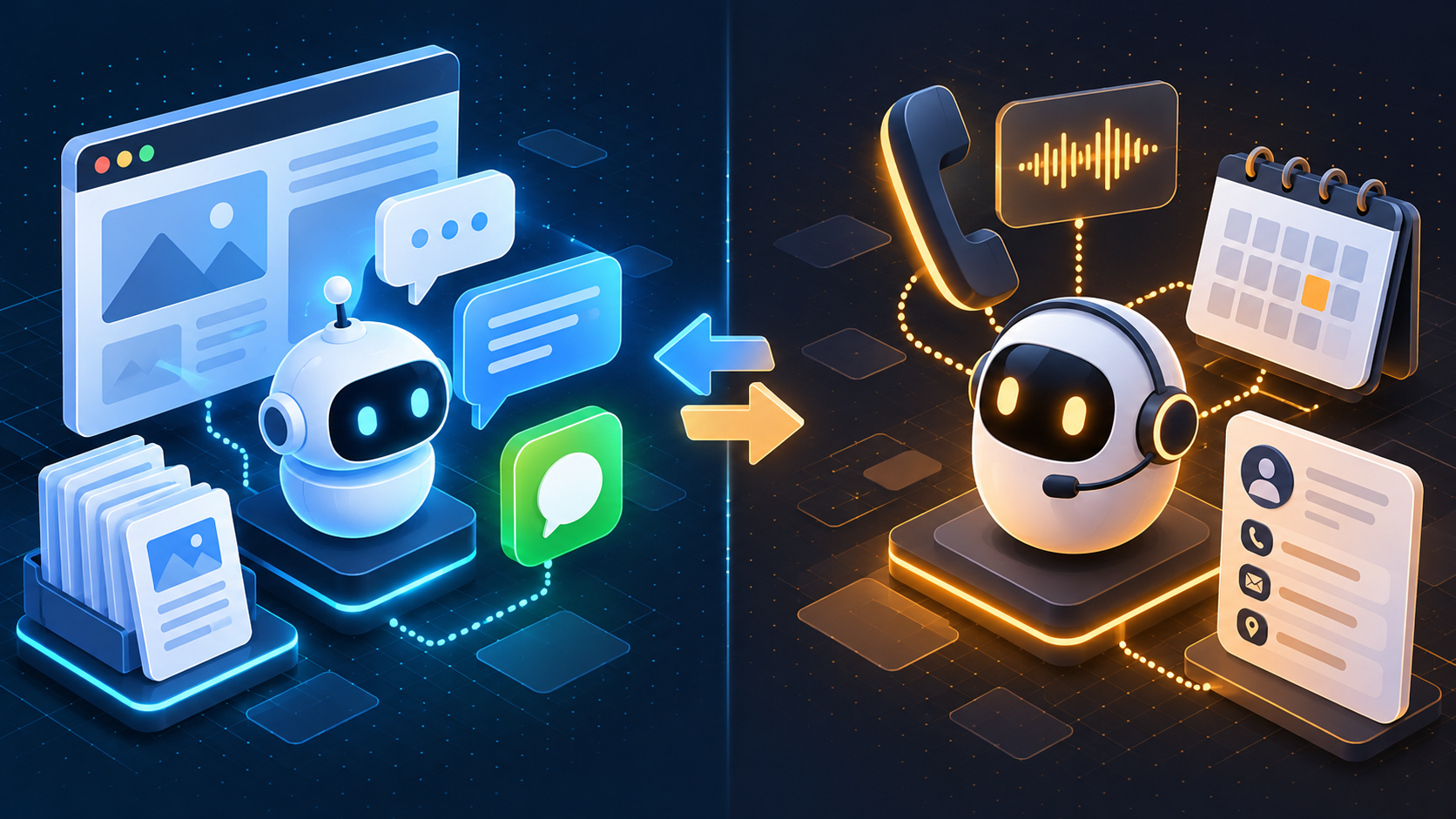
Robofy AI vs Asyntai is a B2B buying decision about operating model, not a beauty contest between chat widgets. Both products use business knowledge to automate customer conversations, but their current official materials show different centers of gravity. Robofy focuses on AI agents for website and WhatsApp conversations, with APIs, webhooks, knowledge retrieval, external actions and human escalation. Asyntai begins with a website-trained assistant and extends into lead capture, custom tools, messaging channels and an AI front desk for connected phone lines. Read our detailed Robofy AI review and Asyntai review for the individual product guides.
The short answer
Shortlist Robofy when you need a customer-experience agent across website chat and WhatsApp, particularly when the assistant must work with an existing support, CRM, booking or lead-routing process. Shortlist Asyntai when a knowledge-based website assistant is the immediate need and a future AI receptionist or phone-answering flow could be useful. Neither should be considered an unattended substitute for policy owners, support teams or sales follow-up. The right product is the one whose permitted actions, source content, channels and handoffs match the work your team can govern.
Use cases and assistant setup
Robofy documents agents configured with a role, instructions, tools and channel settings. Its knowledge base can index URLs, PDFs and FAQs for semantic retrieval. The company describes website and WhatsApp conversations alongside APIs, webhooks and external actions such as bookings or CRM updates. That is relevant when an organization needs more than a FAQ widget: a conversation may need to collect a lead, enforce a defined rule, pass context to a person or request a limited action from a connected system. It is not a promise that every Robofy deployment performs every action; each connection needs to be designed, authorized and tested.
Asyntai’s documented flow begins by crawling a website and optionally using supplied content to create a knowledge base for a site widget. Its live pricing page also describes lead capture, chat logs, analytics, custom notices, escalation, human takeover, bookings, embeds, support tickets and custom tools on qualifying tiers. For a business with repetitive website enquiries about services, availability, policies, products or booking, that website-first approach is clear. But the implementation still needs an owner: someone must remove expired promotions, resolve conflicting policy pages, define unknown-answer behavior and review conversations.
Knowledge sources: accuracy before automation
Both systems depend on the quality of the source material. Robofy publishes support for knowledge sources such as URLs, PDFs and FAQs. Asyntai publishes website crawling and supplied content for its knowledge layer. A good B2B pilot should use one narrow journey—perhaps pre-sales qualification, a product support section or appointment questions—with approved FAQs and a defined escalation list. Test direct questions, vague questions, contradictory source material, requests for a human, and requests for private account data. An assistant should state uncertainty or hand off when the knowledge base does not support an answer. A polished response with invented information is worse than an honest ‘I do not know’.
Channels: chat, messaging and phone
Robofy’s official materials emphasize website and WhatsApp. Its current pricing page also lists meeting integrations, Facebook Messenger, email and callback options, alongside the WordPress plugin. Channel availability and setup can be plan-dependent, so verify the current requirement for each customer-facing channel. WhatsApp is operationally different from a website chat bubble: the buyer needs to establish consent, templates where applicable, ownership of the account, transcript handling and a human route when the conversation becomes sensitive or high value.
Asyntai’s current plan page lists website chat plus Instagram, Messenger, WhatsApp, Discord and Zapier connections. On Standard and Pro, it publishes a voice agent for the widget and connected phone numbers through the customer’s Twilio account. The same page currently lists 200 included voice minutes on Standard and 1,500 on Pro; it says Twilio bills calls separately and that each answer in a call counts as an AI reply. Treat those as published plan details, not a substitute for checking checkout and voice setup. If phone reception is the core reason to buy, confirm the exact number configuration, language fit, transfer rules, notices and telephony cost directly with Asyntai.
Integrations and real-time data
Robofy’s documented API, webhooks and action tooling make it the more natural published fit for teams that already have a system of record and need an agent to participate in a controlled workflow. Do not stop at ‘does it integrate?’ Ask which fields are read or written, what permissions the agent uses, how errors appear, who approves changes and how the business audits the outcome. A public FAQ assistant and an agent that can request CRM or booking actions have materially different risk profiles.
Asyntai publishes a REST API and says that Custom Tools can call customer API endpoints for live, request-specific data including order status, stock, tracking and account lookups. Its pricing page places custom tools and real-time data features on higher tiers. This is useful only when the upstream data and access control are reliable. Test every live lookup, blocked request and timeout before allowing an assistant to make claims about an order, account or availability. Integration capability is not the same as a finished, safe integration.
Privacy, guardrails and human handoff
Neither platform removes a buyer’s responsibility for personal data. Map what visitors provide, where transcripts live, retention periods, staff access, exports and any downstream systems that receive information. Robofy’s enterprise materials state ISO 27001 compliance, TLS encryption in transit, AWS KMS encryption at rest and GDPR-ready positioning; confirm the plan scope and contractual terms that apply to your account. Asyntai’s existing product guide notes its published EU data-storage statement, but that does not remove the need for a business-specific data-processing, retention and legal assessment.
Build human escalation into the original design. Escalate complaints, refunds, account-specific questions, safety or legal topics, payment disputes, sensitive personal information and anything unsupported by the knowledge base. Review whether the staff member receiving a handoff has enough context to help without making the visitor repeat the conversation. Phone workflows need the equivalent: transfer conditions, live hours, callback capture and a clear owner. The metric is not raw chat volume; it is whether correct answers, qualified leads and handoffs improve without creating avoidable risk.
Current published pricing: compare the model, then confirm
Robofy’s live pricing page currently displays Starter at $19/month, Pro at $99/month and Enterprise at $399/month, with a free trial and annual-billing discount. It describes AI credits for text replies, voice activity and training, and says actual message capacity varies with the AI model and training resources. The page lists training sources, chat inbox, API and webhook access, plus selected integrations. Because plan tables evolve, use the vendor’s live page and written clarification for any number that determines your purchase, particularly agent count, training limits, required channel access and projected credit consumption.
Asyntai’s live pricing page currently displays Free at $0, Starter at $39/month, Standard at $139/month and Pro at $449/month. It publishes 100 AI replies on Free, 2,500 on Starter, 15,000 replies and 200 voice minutes on Standard, and 50,000 replies with 1,500 voice minutes on Pro. Annual billing is shown at a lower effective monthly rate. These are current published figures, not permanent commercial terms. Check regional tax, traffic peaks, behavior at the message cap, voice-provider costs and feature gates before entering a contract.
Who should choose Robofy?
Robofy is the stronger shortlist for a B2B team whose priority is website plus WhatsApp conversation automation and whose roadmap includes APIs, webhooks or defined actions. It is also relevant to agencies considering a white-label service. Select it only after validating the actual knowledge controls, integration permissions, escalation route and credit economics for one real workflow. For the full product breakdown, see the Robofy AI buyer guide.
Who should choose Asyntai?
Asyntai is the stronger shortlist for an organization that wants a knowledge assistant on its website today and a published path to lead capture, live-data tools and a controlled AI receptionist later. It is especially worth testing for businesses with reliable content and repeat visitor questions. The decision should include the human team that will own content updates and call escalation, along with the combined cost of the subscription and Twilio where voice is used. See the Asyntai review and receptionist guide for a deeper assessment.
Final verdict
Robofy and Asyntai are both credible B2B options, but they should be judged through the workflow they must support. Robofy is the more natural published fit for cross-channel customer experience and connected operations; Asyntai is the more natural fit for a website assistant with a possible front-desk and phone layer. Start with a small, governed pilot, measure answer accuracy and handoff quality, and expand only once the knowledge base, integrations and people are ready.